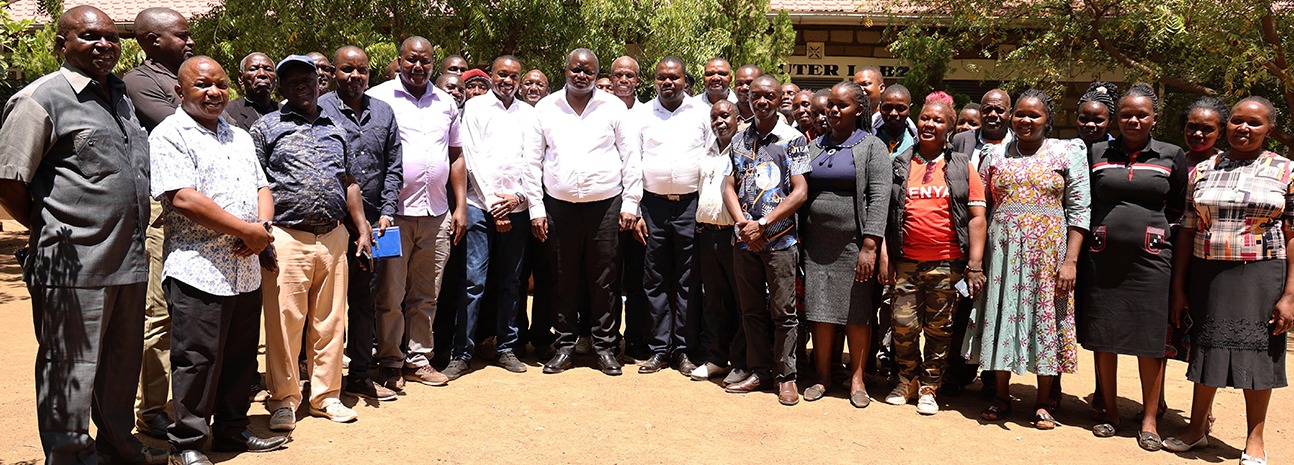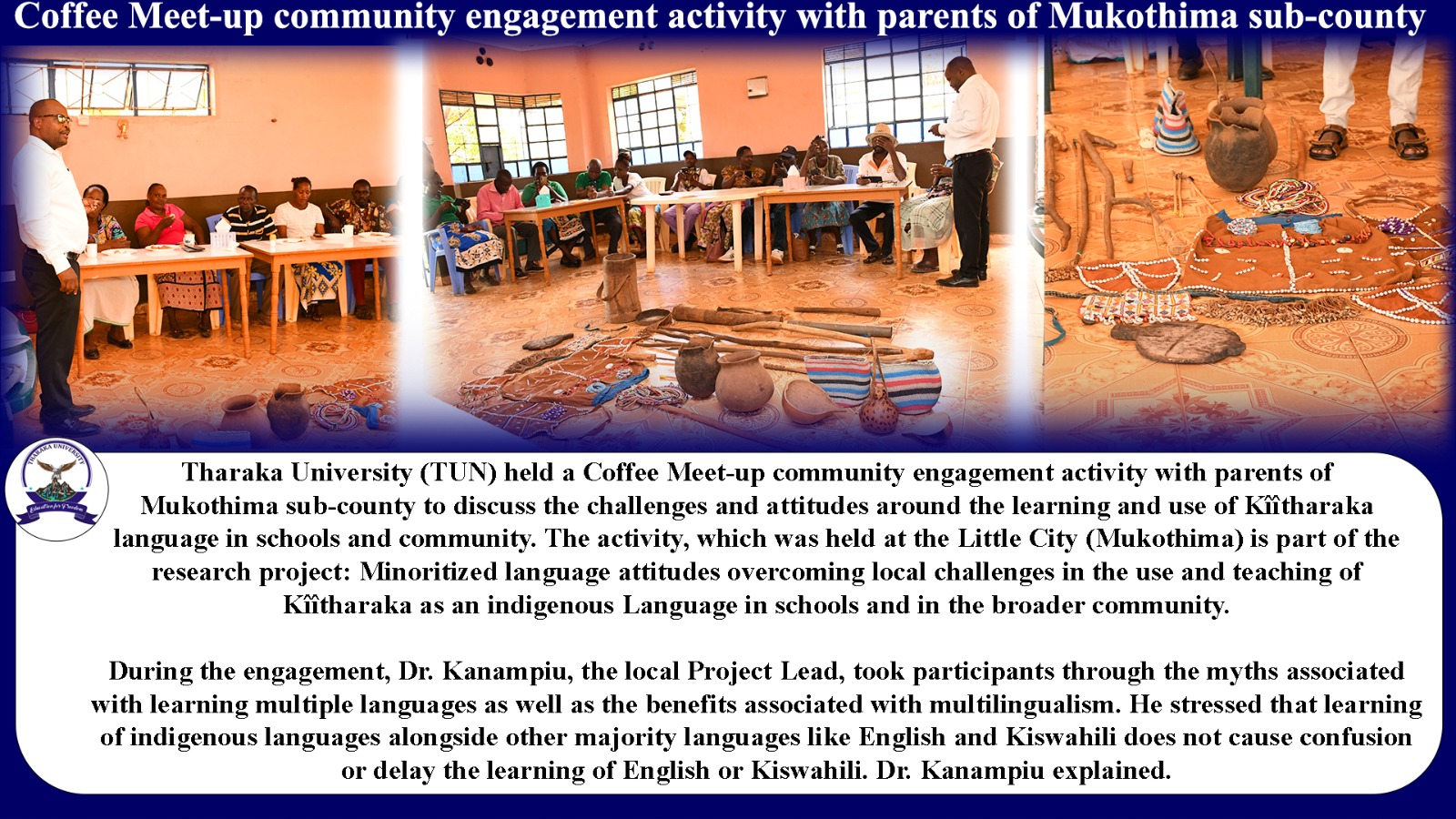
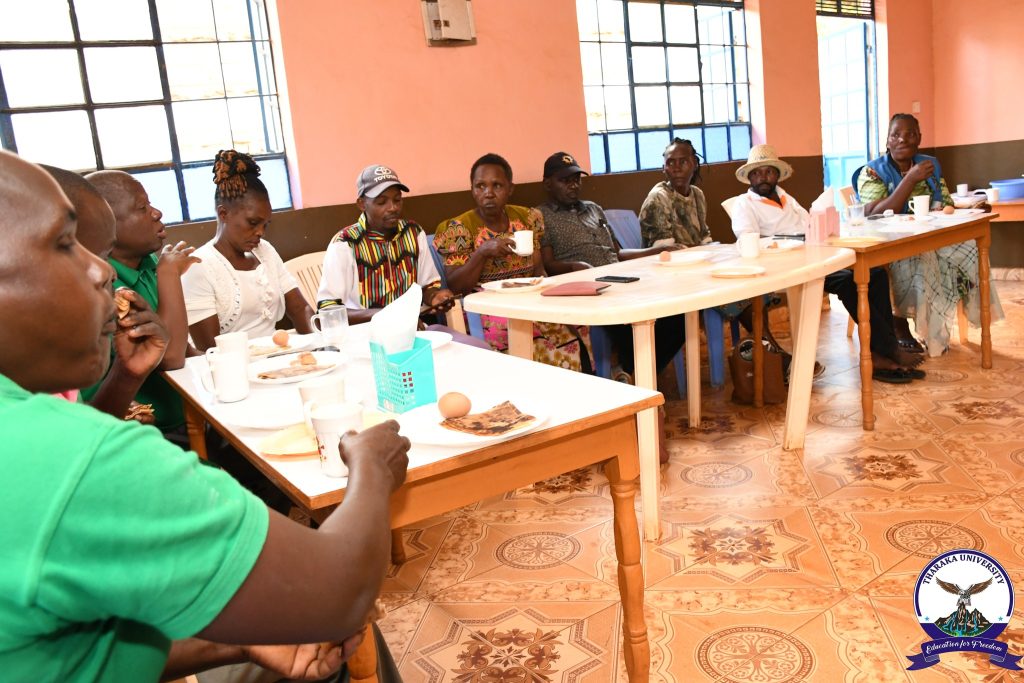
Tharaka University (TUN) held a Coffee Meet-up community engagement activity with parents of Mukothima sub-county to discuss the challenges and attitudes around the learning and use of the Kîîtharaka language in schools and the community. The activity, which was held at the Little City (Mukothima) is part of the research project: Minoritized language attitudes overcoming local challenges in the use and teaching of Kîîtharaka as an indigenous Language in schools and in the broader community.
During the engagement, Dr. Kanampiu, the local Project Lead, took participants through the myths surrounding learning multiple languages and the benefits of multilingualism. He stressed that learning of indigenous languages alongside other majority languages like English and Kiswahili does not cause confusion or delay the learning of English or Kiswahili. “Research evidence shows that children learn mathematics and acquire literacy skills much earlier, if these are delivered in a language they understand and speak,” Dr. Kanampiu explained. He encouraged the parents present to support efforts to encourage teaching and learning using their mother tongue at the lower grades. He emphasized that allowing children to learn and use the Kîîtharaka language would save the language from eventual death and as well as preserve Kîîtharaka culture.
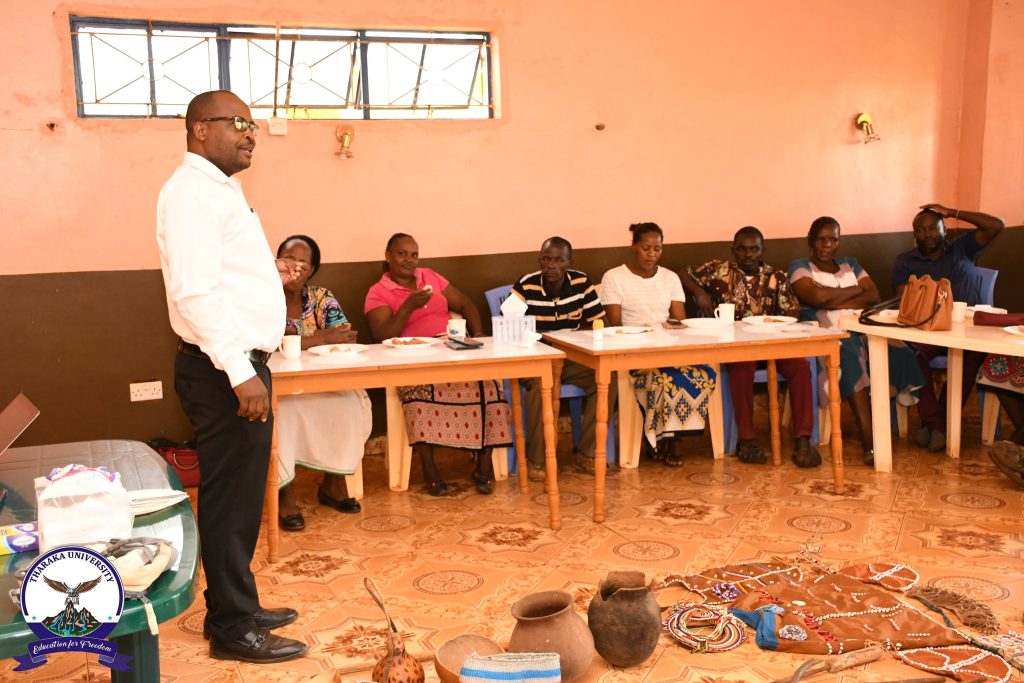

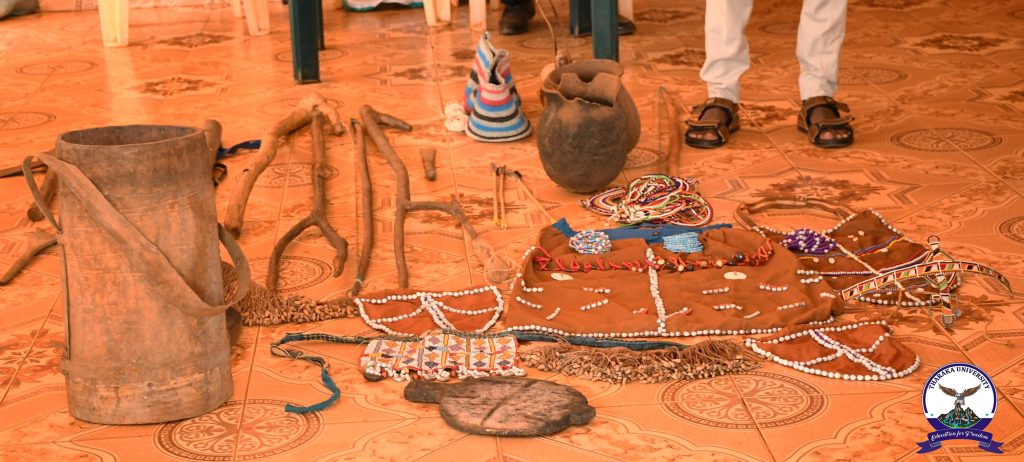
The parents also displayed different Kîîtharaka cultural artefacts. It was noted that artefacts define culture, and that we learn their use and purpose through language. For instance, the traditional beehive hook, known locally as ‘mpogoro,’ is not just a tool for supporting the beehive but a symbol of balance and sustainability. One does not harvest honey beyond the hook—doing so would leave no honey (food) for the bees and they would leave the beehive. These artefacts illustrate the depth of cultural knowledge conveyed through Kîîtharaka, embodying rituals and social practices unique to the community. It was also noted that indigenous languages form cultural well-being for society, the economy, and political matters. However, with the dilution of such languages, there’s an imminent risk of losing these rich cultural tapestries, highlighting the importance of preserving Kîîtharaka.
Participants completed a survey to evaluate their understanding of the challenges and issues around the learning and use of Kîîtharaka in the community.
This ongoing study is a collaborative project between Tharaka University and the University of Edinburgh (United Kingdom). The other co-investigators include Dr. Alexander Martin, University of Groningen (Netherlands), Prof. Vicky Chondrogianni (University of Edinburgh), and Jennifer Culbertson (University of Edinburgh). In this project, Tharaka University is also partnering with two local organizations — Bible Translation (BTL) and Society for Alternative Learning & Transformation (SALT). The research project is funded by the Economic and Social Research Council (ESRC) Impact Acceleration Account through the University of Edinburgh.
www.tharaka.ac.ke #Tharakauni #Educationforfreedom #Kîîtharaka #research